The opening of the first cableway to Klein Titlis in 1967, just over 200 meters below the rugged summit, marked the beginning of a continuous expansion of the existing infrastructure. Today, around 1.1 million people visit Titlis each year, roughly a quarter of them traditional winter-sports guests. The majority are international travelers who come to experience the mountain and its landscape. Over the decades, this has given rise to a varied tourist infrastructure, including restaurants, shops, a glacier cave, and a suspension bridge, amongst other attractions.
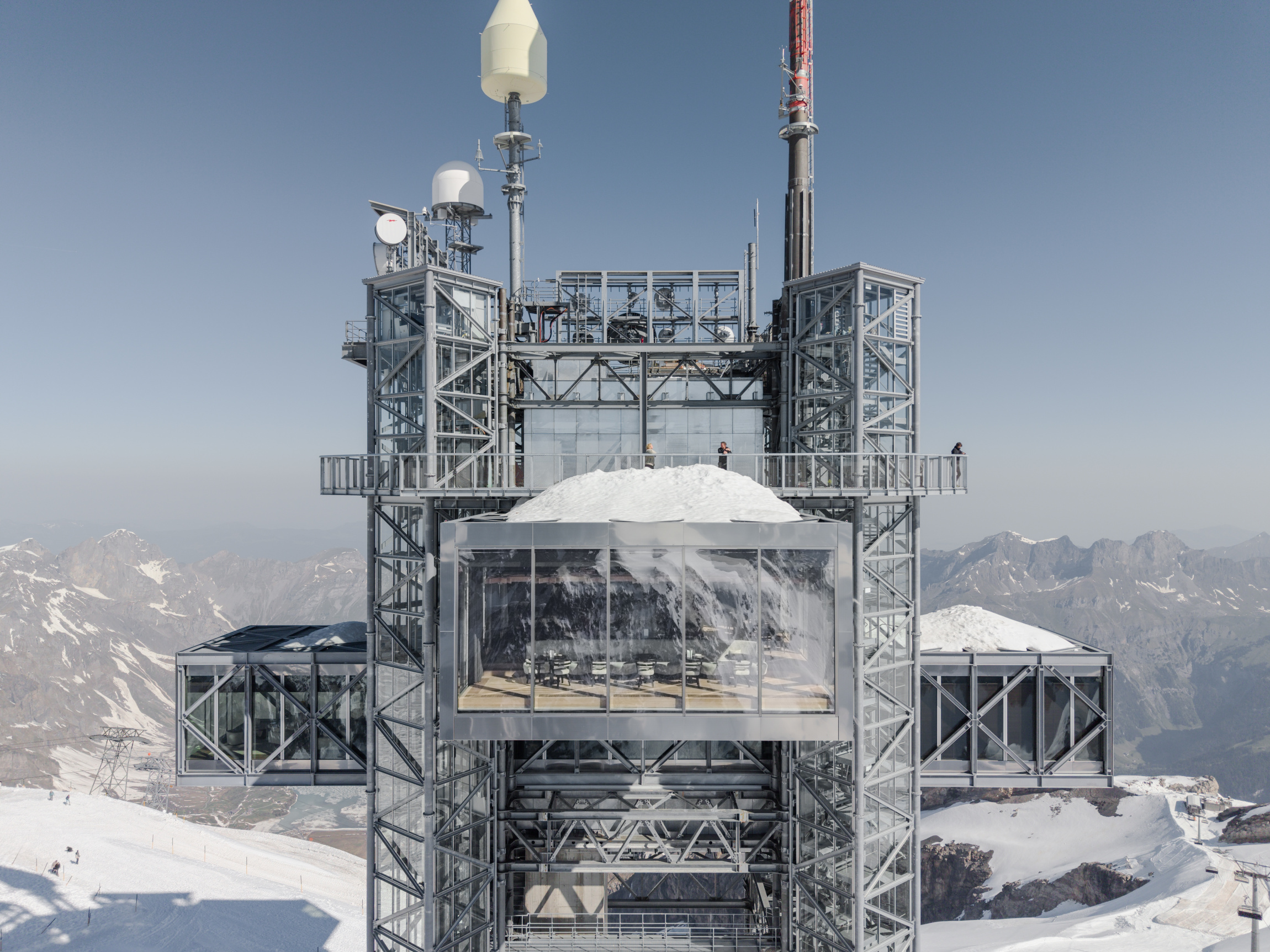
This organically evolved ensemble has reached its limit. Successive additions have resulted in a complex mountain station that no longer meets today’s requirements for capacity, orientation, and visitor flow. The acquisition by Titlis Bergbahnen of the 1980s antenna tower from the Swiss Army added a further element, including an underground tunnel connecting the tower directly to the mountain station and glacier cave below. This tower was our starting point for rethinking the tourist infrastructure and designing it for today’s needs: moving beyond purely functional structures towards an integrated architectural concept.
Overall Concept
In 2017, Herzog & de Meuron was commissioned to renew the mountain station as part of a masterplan for the entire summit, and to transform the antenna tower into part of the visitor experience. A central element of the concept is the resource-conscious development of the existing structures. Elements including the tower, the tunnel, and the cableway station are retained and integrated into the new overall system.
An assessment of the existing mountain station, particularly its load-bearing structure, showed that a conversion of this building would not be able to sufficiently resolve the fundamental issues of circulation, orientation, and capacity. While some elements of the mountain station are being kept for reuse, a portion of the existing structure will be replaced by a new building that encloses the existing cableway station. The energy consumption of all buildings, including the tower and mountain station, will be significantly reduced through intelligent building technology.